
How to Design a Beautiful Shade Garden: A Simple Layering Formula
THE EUROPEAN GARDEN EDIT
GARDEN DESIGN
How to Design a Beautiful Shade Garden: A Simple Layering Formula
A simple layering formula for a lush, cohesive and considered shade border
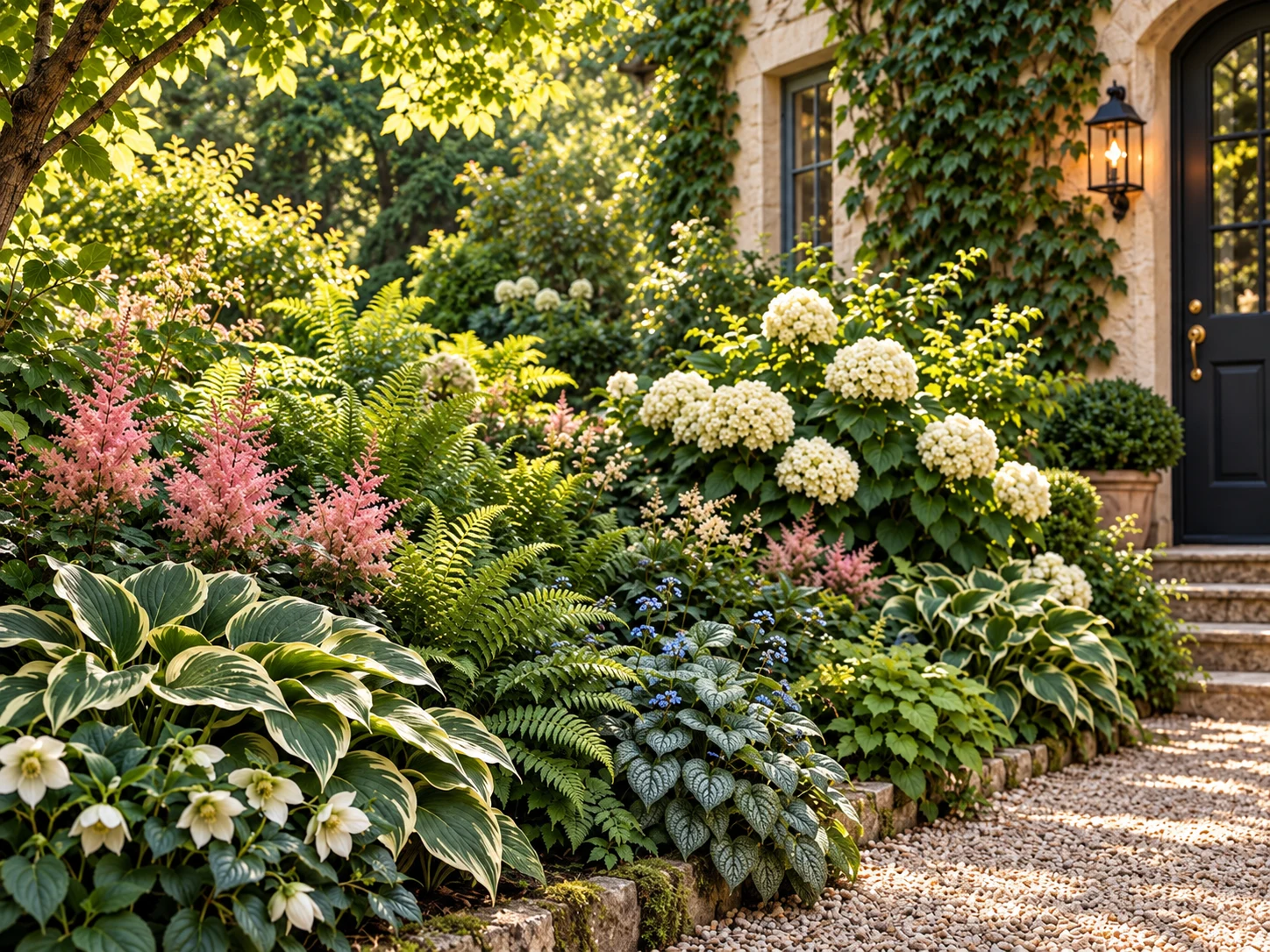
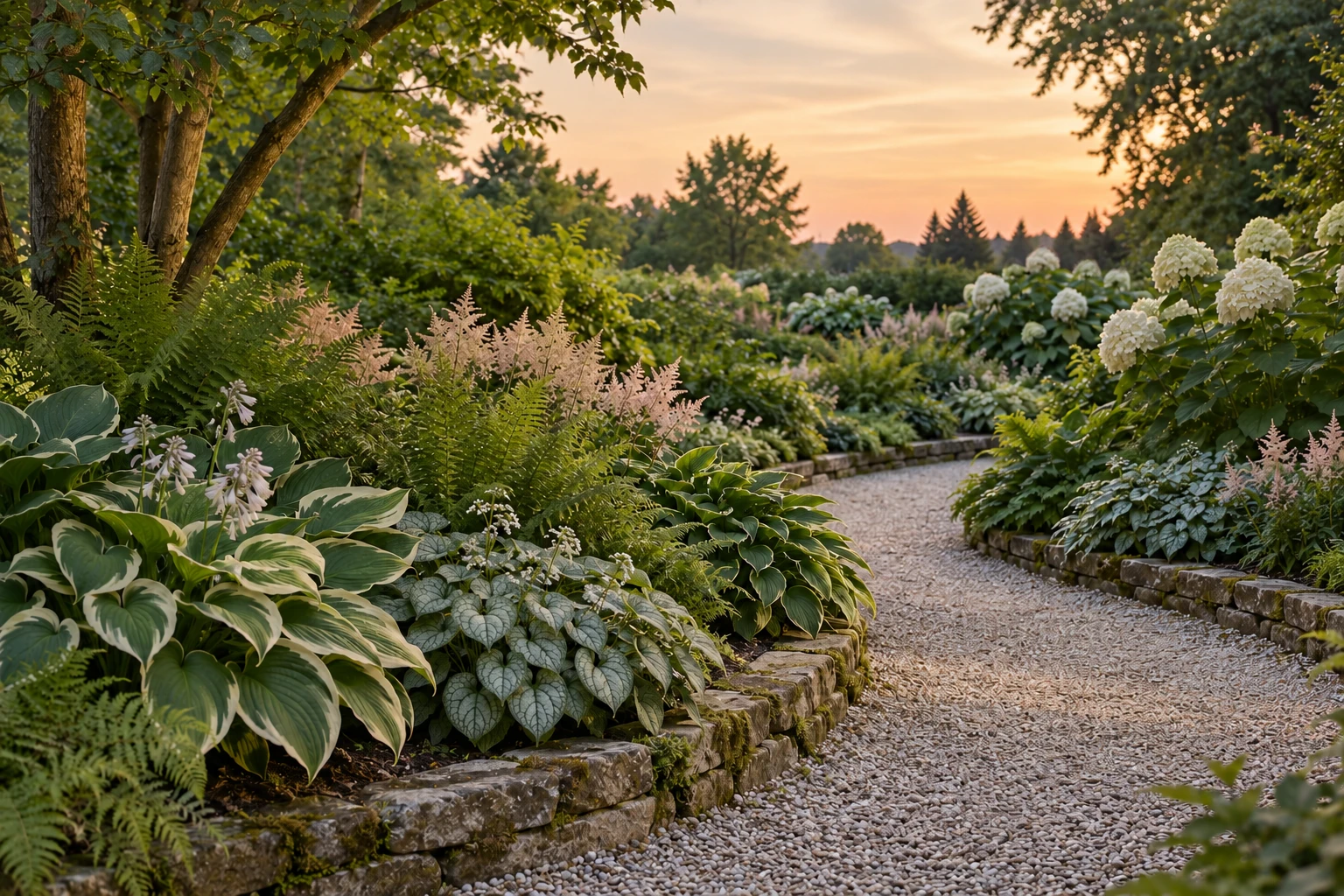
A beautiful shade garden begins with more than a list of plants that tolerate low light. The borders that feel lush and intentional have a clear framework: taller structure, a generous middle layer and a softer foreground. Their interest comes from contrasting leaves, repeated shapes and enough space for each plant to develop.
Flowers bring seasonal pleasure, but foliage holds the composition together. Here, we’ll work through a simple layering formula you can use to plan a new shade border or bring more cohesion to an existing one, always adapting the planting to your light, soil and moisture.
Key Takeaways
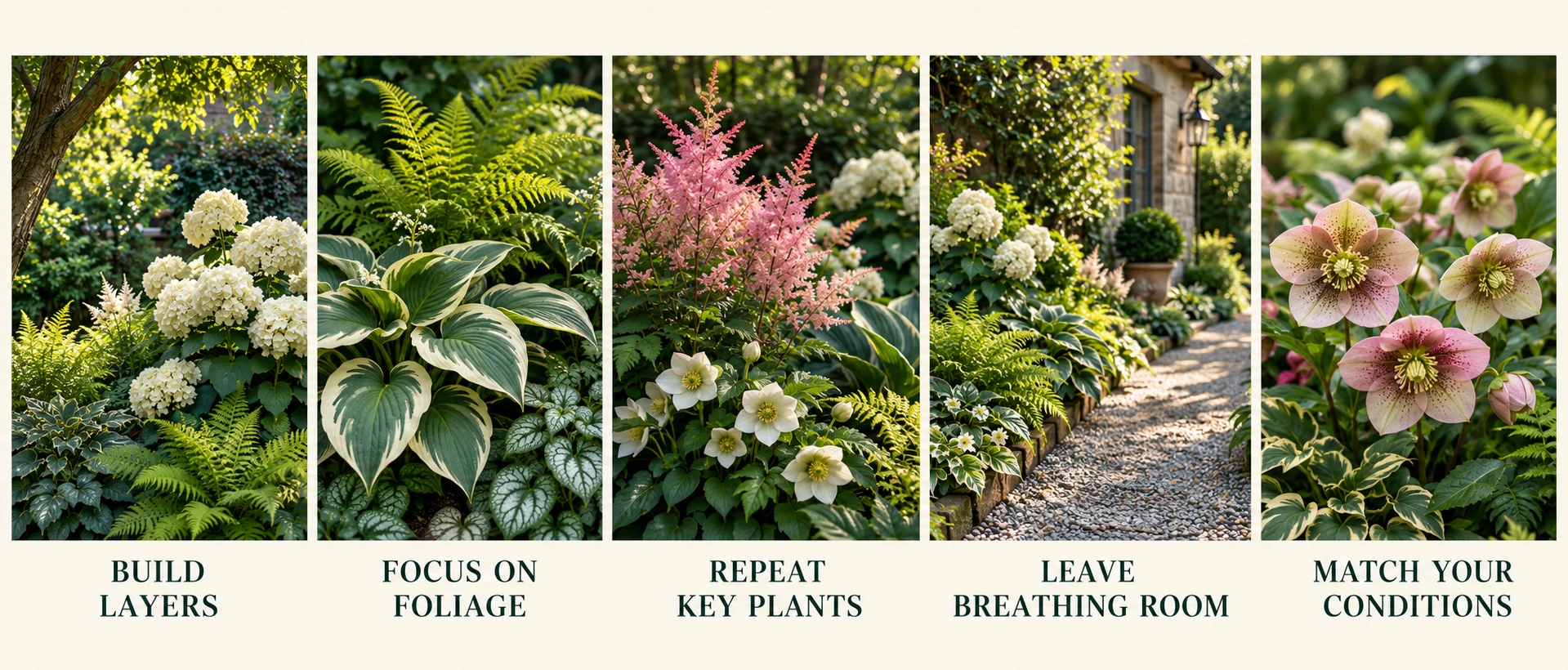
- Build the garden in layers: structure, middle planting and foreground.
- Choose plants for foliage, texture and form—not flowers alone.
- Repeat a smaller number of plants to create rhythm and cohesion.
- Leave enough space for plants to reach their mature size.
- Match plants to your actual shade and moisture conditions.
- Use flowers as highlights within a strong framework of foliage.
Why Some Shade Gardens Feel Flat
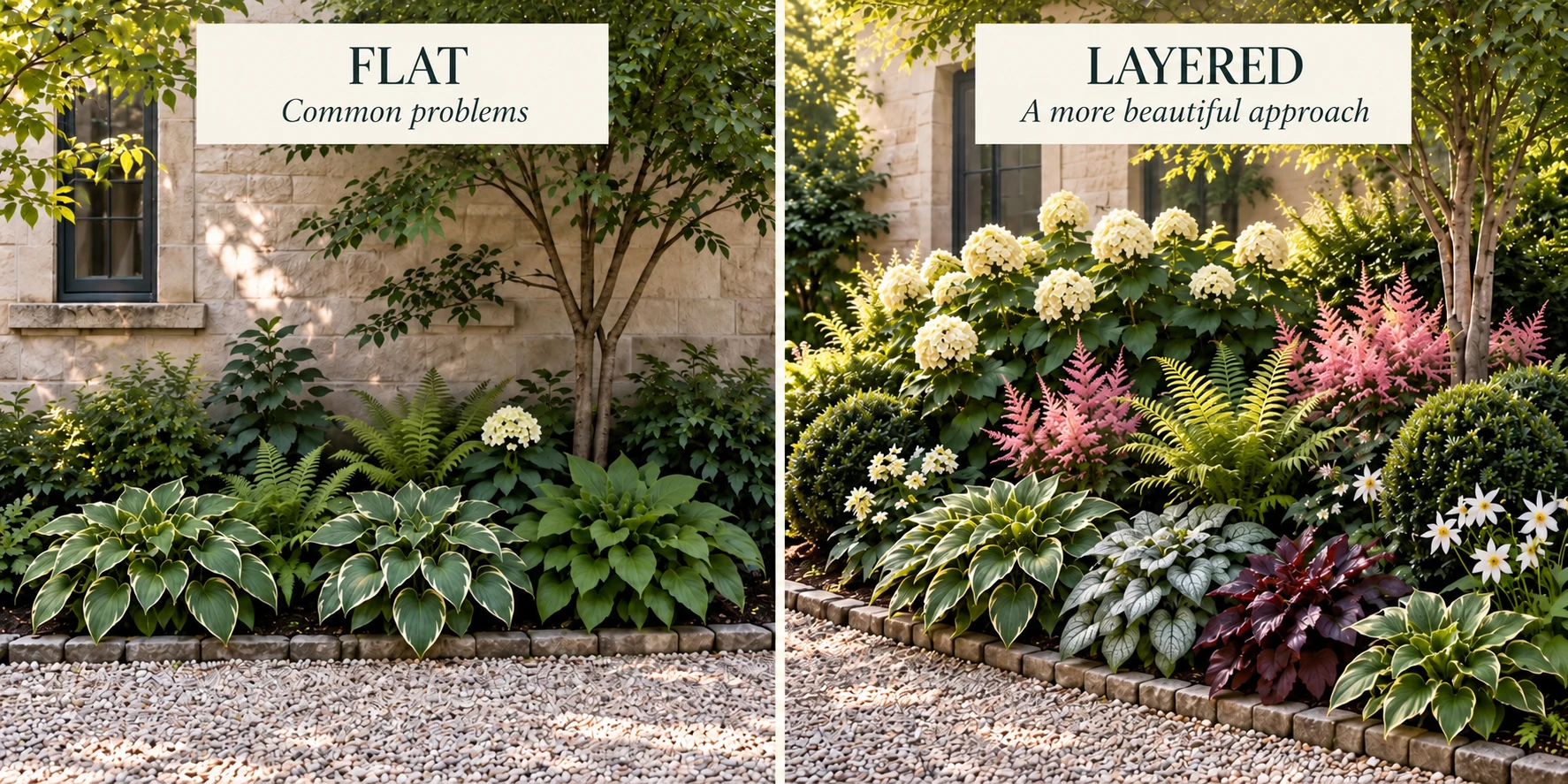
A border can contain lovely plants and still feel disconnected. Often, everything sits at roughly the same height. Without a taller anchor or a lower edge, the eye meets a single band of planting rather than a composition with depth.
Another common problem is collecting one of everything. Each plant may be attractive, but too many isolated varieties leave little rhythm. Similar green leaves can also merge into one indistinct mass, especially where there is no structural backbone.
The solution is layering. Think about how plants relate to one another before deciding which individual specimens to buy. A few deliberate changes in height, leaf shape and placement can make an existing border feel far more considered.
Start With Structure
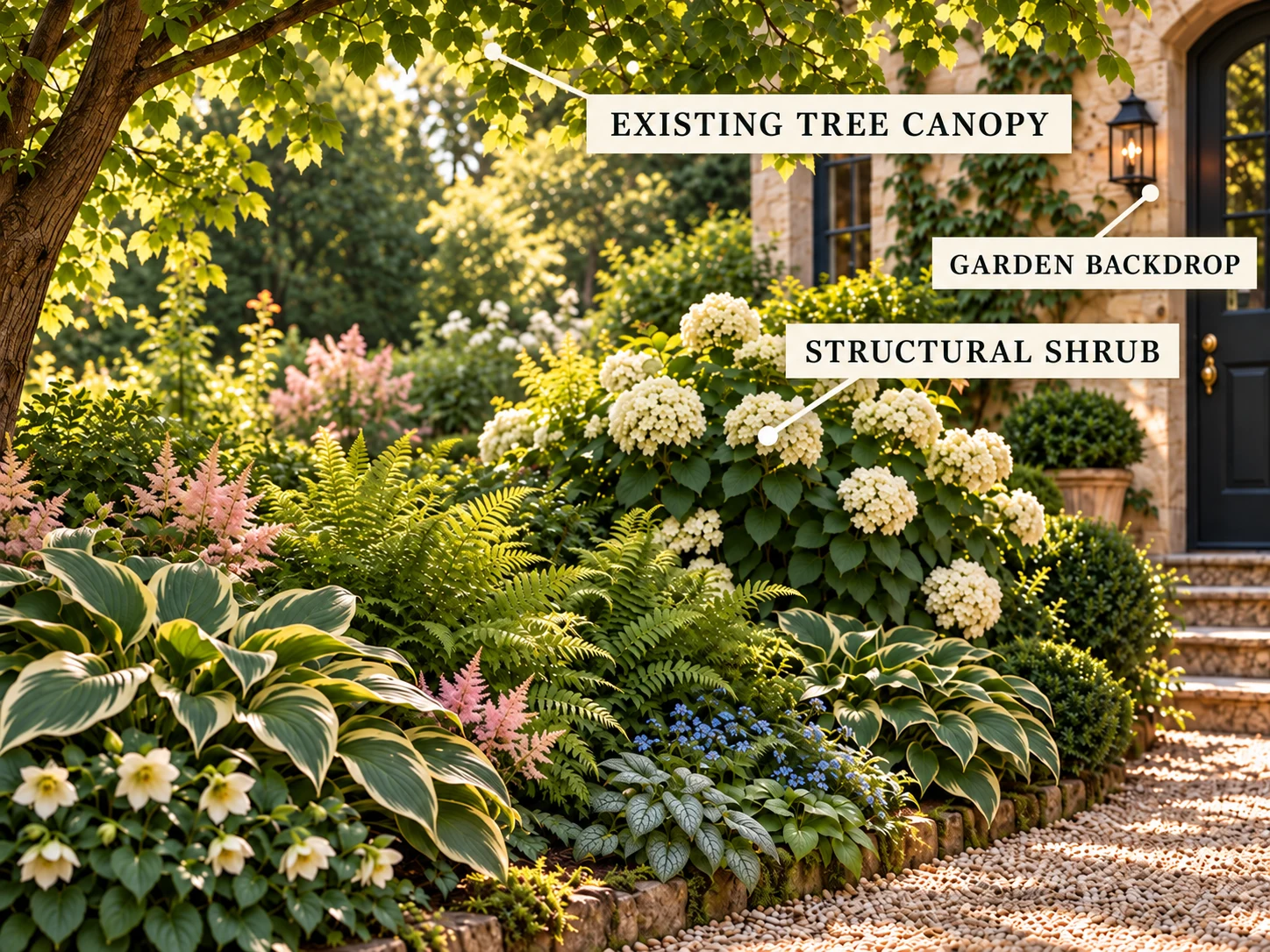
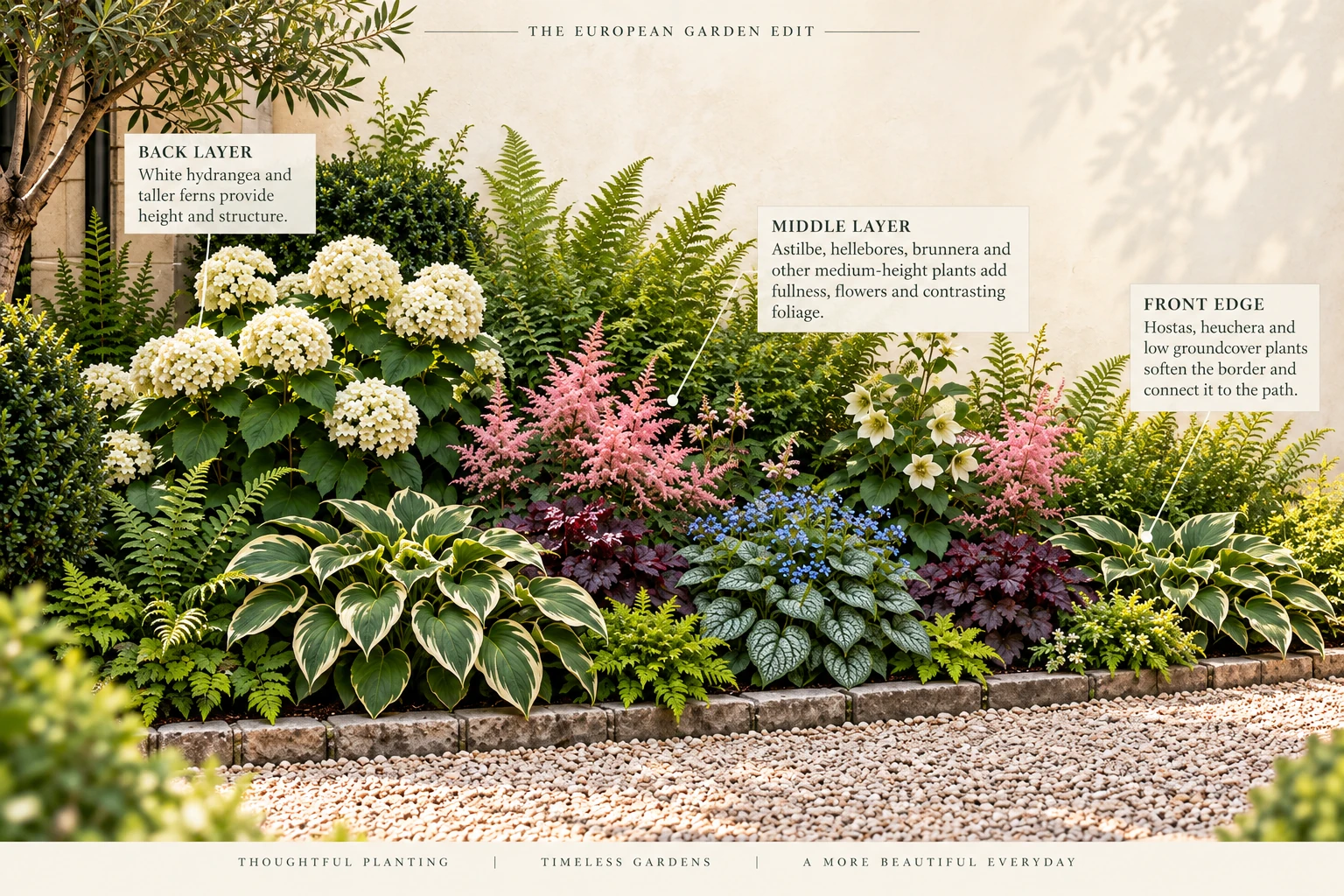
Begin with the largest shapes. These establish the scale of the border and provide a backdrop for smaller plants. A suitable hydrangea, a substantial fern, an existing mature tree or an evergreen shrub can all contribute structure.
Look at what is already there. A weathered stone wall, a hedge or the architecture of the house may provide enough definition without adding another large shrub. Draw these elements onto a simple sketch first, including windows, doors and the path.
Choose structural plants by their mature height and width, leaving clearance for access and buildings. Hydrangeas need enough light to flower well; an evergreen suited to your conditions may be a better anchor in darker shade. Deciduous shrubs provide branching shape in winter, while evergreens and hardscape can retain a stronger presence when perennials disappear.
Add the Middle Layer
The middle layer connects the backdrop with the front of the border. Without it, a tall shrub behind a row of tiny plants can look abrupt. Medium-height planting creates a gradual change of scale and makes the garden begin to feel lush.
Astilbe, hellebores, brunnera, medium-sized hostas and suitable ferns can fill this role. Their position depends on the cultivar: a compact fern and a large hosta will occupy very different amounts of space. Consider the height of the foliage as well as flower stems.
Arrange the middle layer in loose groups that weave between the larger anchors. Let a few plants move slightly forward or back instead of making a straight row. Choose companions with compatible moisture needs; a beautiful combination is only useful if the plants can thrive together.
Finish With the Foreground
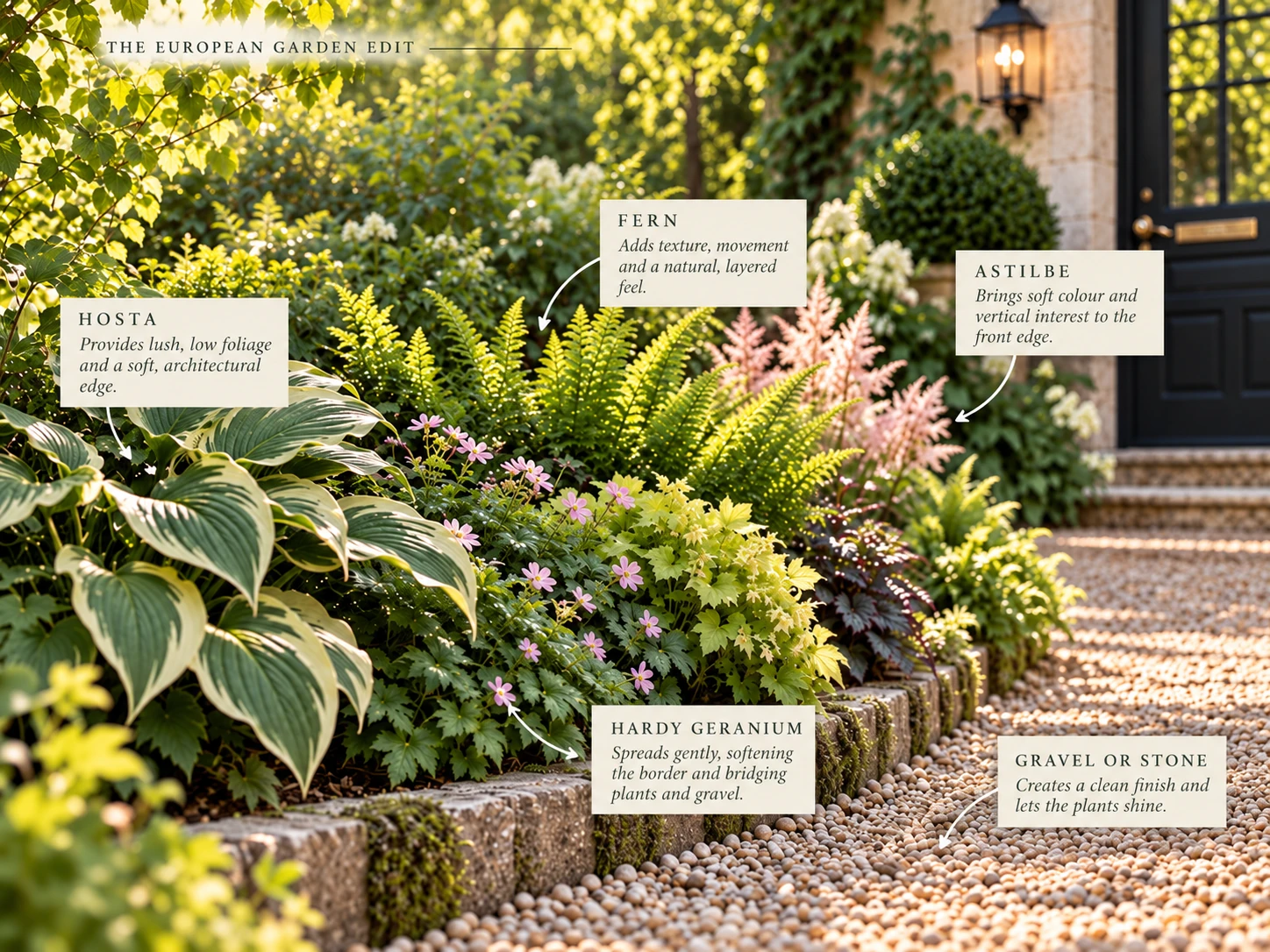
Lower plants soften the meeting point between the border and gravel, stone, lawn or a path. They draw the eye into the planting and make larger leaves behind them feel grounded.
Compact hostas, shade-suited hardy geraniums, epimedium, heuchera and smaller ferns are useful possibilities. Check the specific plant’s eventual spread and growing requirements. A vigorous geranium may need much more room than a miniature hosta.
A little planting can spill gently towards the edge, but leave the route itself clear. Visible gravel and weathered stone give the composition breathing room and make the garden feel refined. You do not need to hide every inch of the edging beneath leaves.
Think Foliage First, Flowers Second
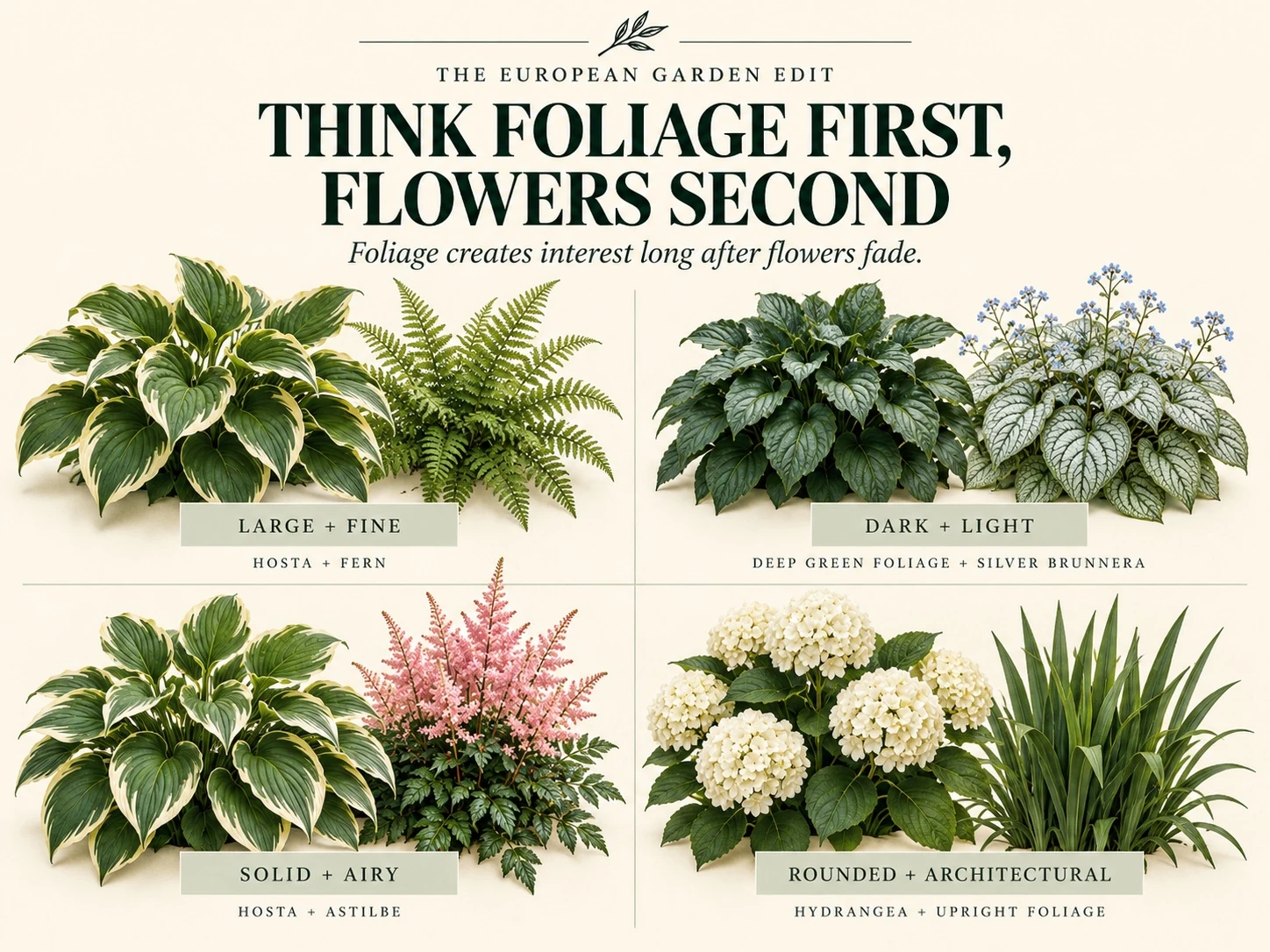
In many shade gardens, flowers are brief visitors while foliage shapes the border for months. Start by imagining the planting without a single bloom. Would the leaves still create an interesting composition? If so, you have a strong foundation.
Contrast works best when it is deliberate. A broad leaf beside a fine frond lets you appreciate both. A patch of silver against deep green can lift a darker corner without requiring a profusion of flowers.
- Large + fine: broad hosta leaves beside delicately divided fern fronds.
- Dark + light: deep green foliage beside silver-leaved brunnera.
- Solid + airy: a substantial hosta clump with the finer foliage and flower plumes of astilbe.
- Rounded + architectural: a rounded hydrangea with upright or finely textured foliage.
Use two or three strong contrasts and repeat them. Too many variegated, silver and burgundy plants competing for attention can become busy. Remember that hostas and brunnera usually die back in winter; combine seasonal foliage with suitable lasting structure if the border is visible throughout the year.
Repeat Plants for a Cohesive Look
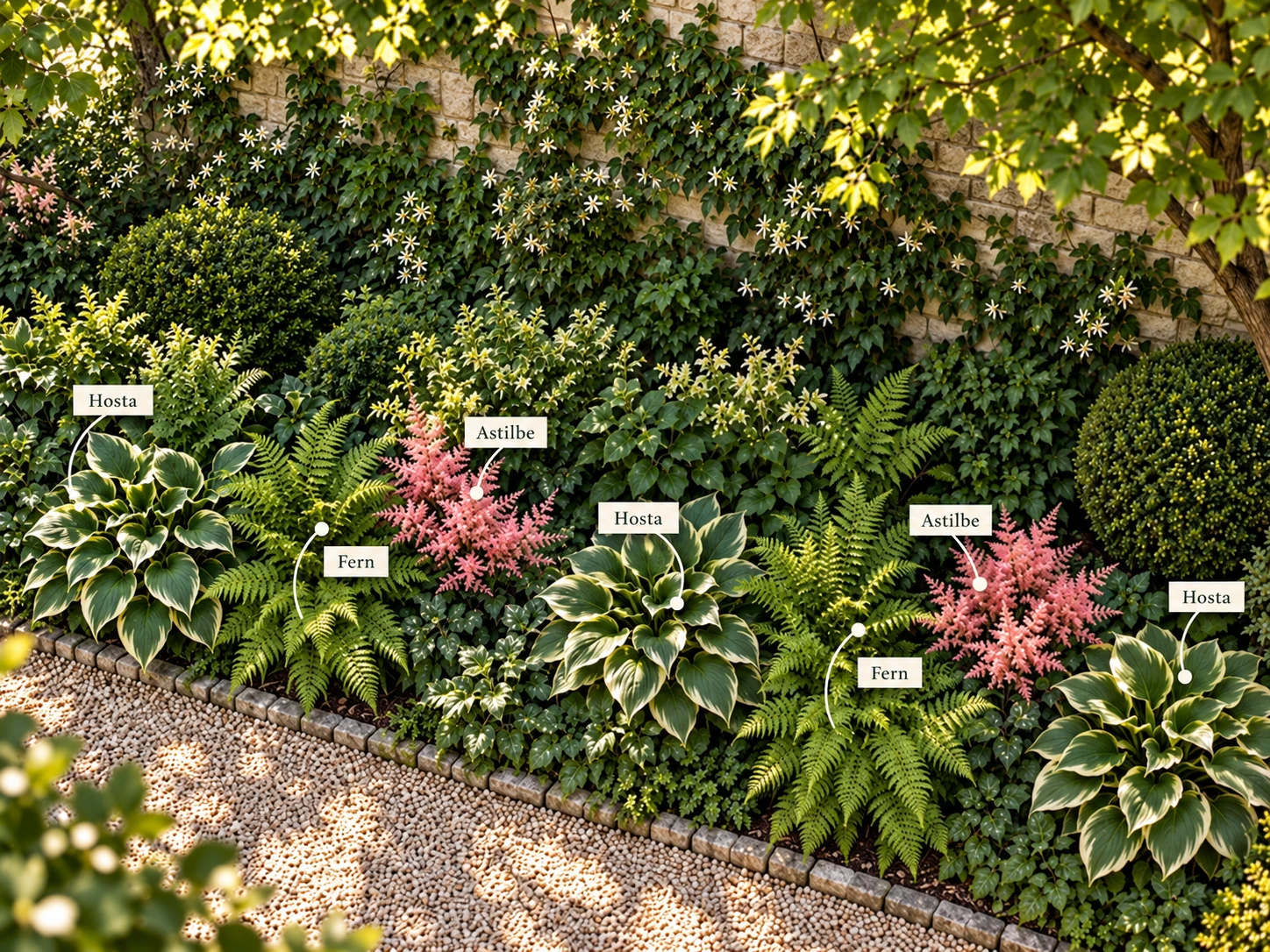
A garden often looks more professionally composed when fewer varieties appear more than once. Repetition gives the eye something familiar to follow and helps separate plant groups feel part of the same border.
Try repeating a hosta cultivar at several points, echoing a fern’s texture further along, or returning to the same astilbe colour. The groups need not be identical or evenly spaced. A larger group in one area and a smaller echo elsewhere can feel natural while remaining cohesive.
Before introducing another variety, ask whether a plant already in the border could do the job. If it thrives there and contributes the right shape, repeating it may be the most effective improvement.
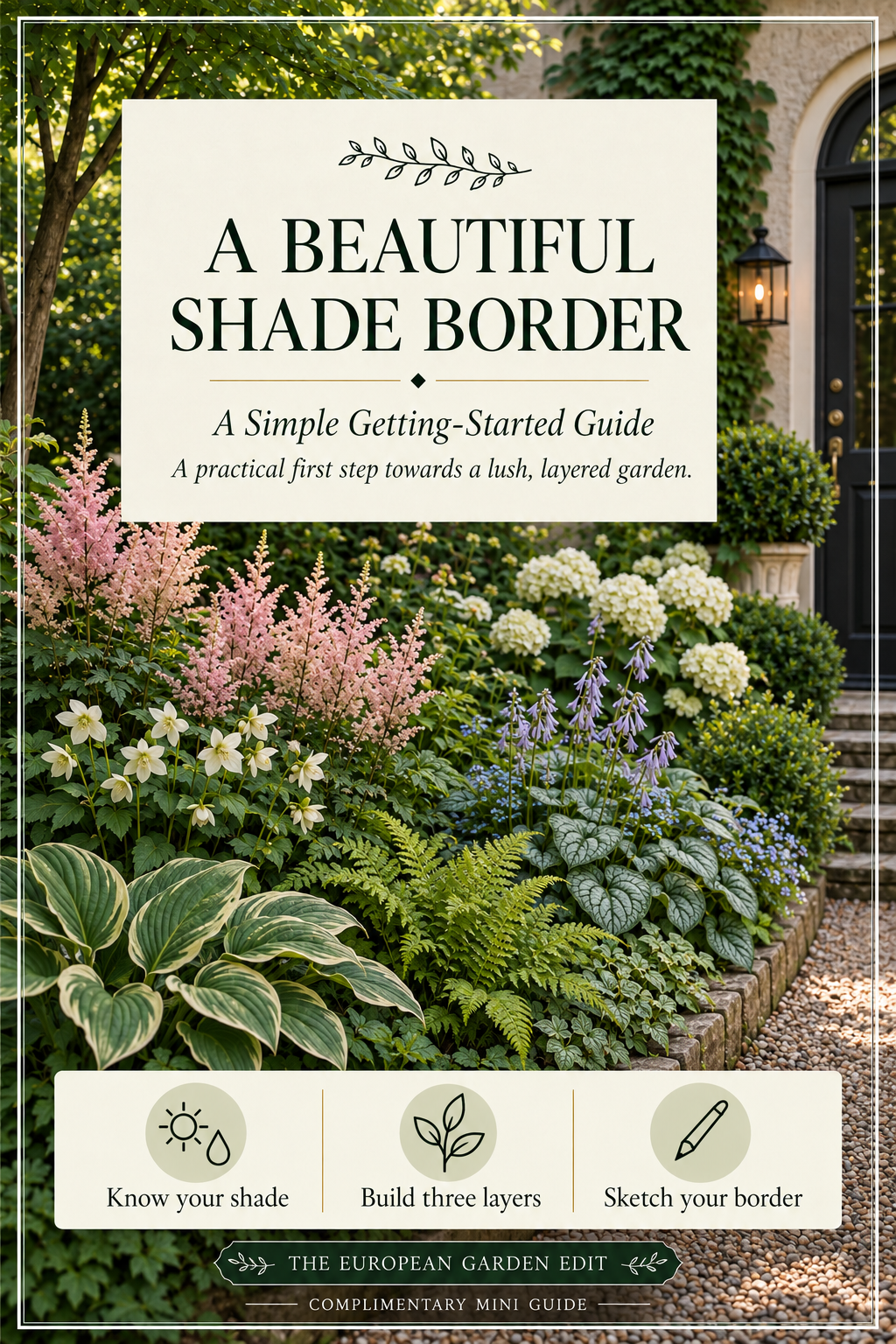
YOUR COMPLIMENTARY 6-PAGE GUIDE
Begin Your Shade Border with Confidence
Receive your complimentary copy of A Beautiful Shade Border, a beautifully designed six-page guide to understanding your shade, building three planting layers and sketching your own border.
COMPLIMENTARY PDF • INSTANT ACCESS
Plus occasional garden notes from The European Garden Edit. Unsubscribe anytime.
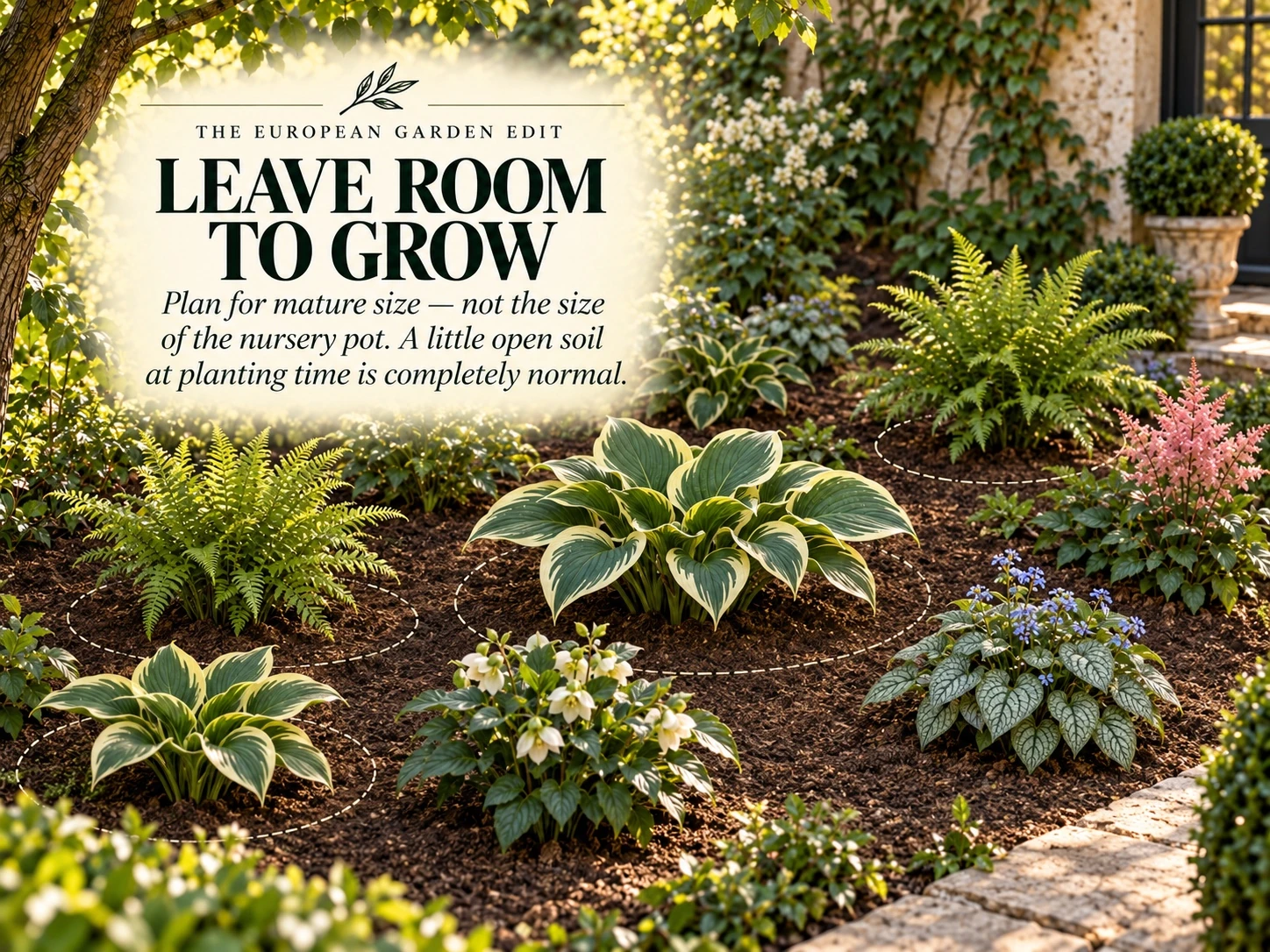
Leave Breathing Room
A newly planted border does not need to look completely full. The plant in a nursery pot is only a starting point; its mature width is what matters when deciding where it belongs.
Mark the expected spread on your sketch before buying. Measure spacing from the centre of one plant to the centre of the next, using cultivar-specific guidance. For two plants of different widths, half of each mature width added together is a useful starting point for foliage that will meet without heavy overlap.
Thoughtful spacing allows airflow, makes weeding and watering easier, and preserves the intended layers as plants grow. Visible soil or mulch at planting time is normal. Mulch suitable open areas rather than filling every gap with another perennial, keeping it away from crowns and woody stems.
Use Flowers as Highlights
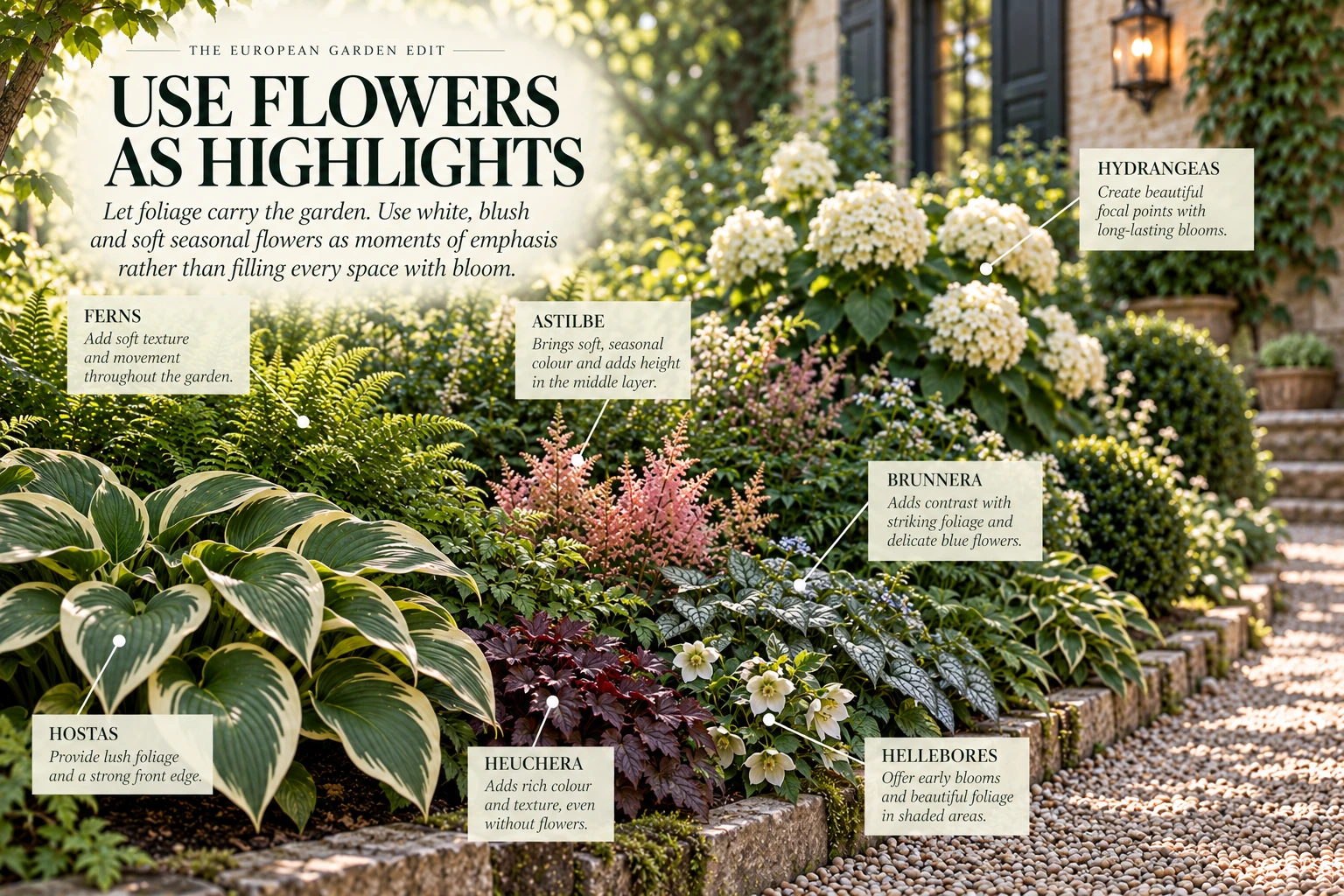
A shade garden can feel abundant without being packed with blooms. Flowers are especially beautiful when they appear as points of emphasis within a quieter framework of leaves.
White hydrangeas can create a summer focal point where light and moisture suit them. Soft pink astilbe brings a finer vertical accent in moisture-retentive soil, while hellebores provide interest earlier in the year. Small blue or white flowers can add detail without dominating the border.
Plan a sequence of highlights rather than expecting everything to flower together. Hellebores, spring-flowering brunnera and summer astilbe or hydrangeas may contribute at different times. Choose a restrained flower palette, then allow foliage to connect those seasonal moments.
The Simple Shade-Border Formula
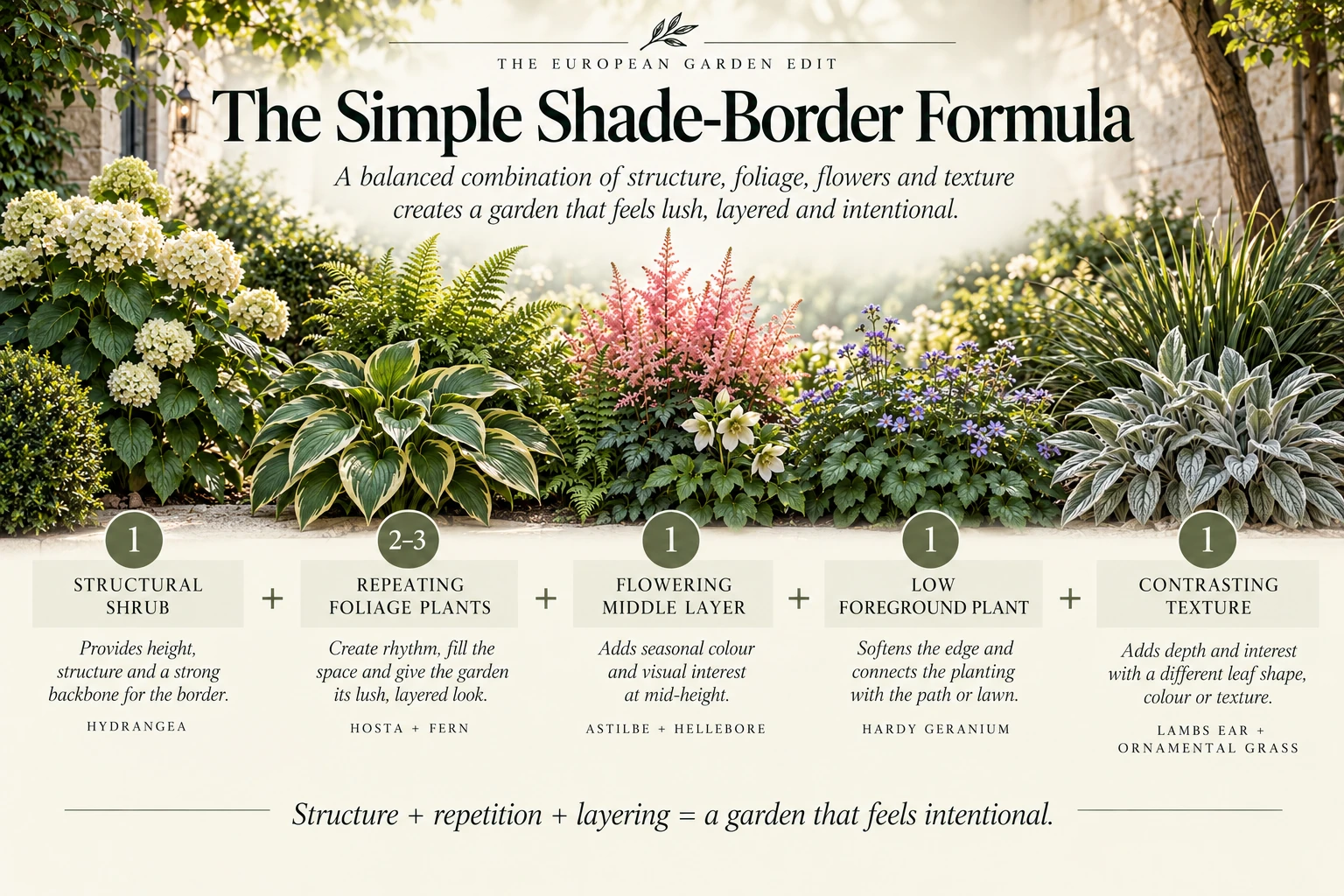
For a manageable starting point, think in roles:
1 structural shrub
+ 2–3 repeating foliage plants
+ 1 flowering middle layer
+ 1 low foreground plant
+ 1 contrasting texture
This is a framework rather than a rigid recipe. The numbers describe plant choices or roles, not the total number of specimens to purchase. Repeat those choices in quantities that fit your measured space and their mature spread.
A fern might provide both recurring foliage and contrasting texture; astilbe can contribute to the middle layer before its flowers appear. Adapt each role to your climate, soil, moisture and light. Silver brunnera may provide contrast in a cool shaded border, while sun-loving silver plants such as lamb’s ear are not a dependable choice for damp or deep shade.
Understand Your Type of Shade
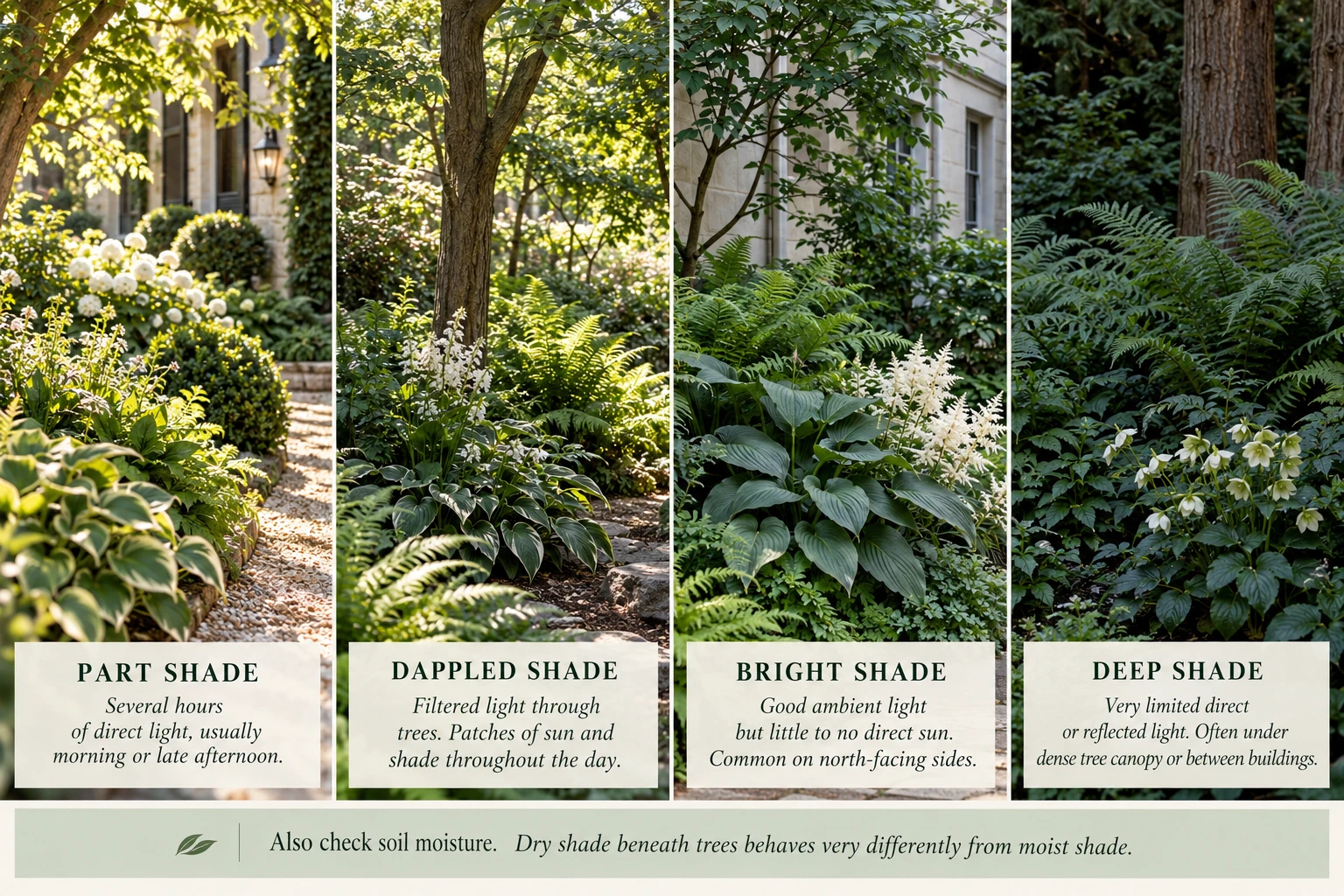
Shade is not one fixed condition. Observe the border at several times of day during the growing season, particularly after nearby trees have leafed out. Record where direct sun reaches the ground and where the light remains filtered or indirect.
- Part shade: several hours of direct light, often around three to six hours daily. Morning sun usually creates different growing conditions from hot afternoon exposure.
- Dappled shade: changing patches of filtered sunlight beneath trees.
- Bright shade: good ambient light with little direct sun. This is a useful description of the site, rather than a standard plant-label category.
- Deep shade: very limited direct or reflected light, such as beneath dense evergreen cover or in an enclosed corner.
Moisture matters just as much. Dry shade beneath mature trees includes root competition and often less rainfall reaching the soil. Shade beside a building may also be dry under an overhang; a woodland edge may retain more moisture. Check the soil instead of assuming.
Moist shade can suit many hostas and astilbes, while selected epimediums and other dry-shade plants may be better beneath trees. All new plants need establishment care. Avoid cutting substantial tree roots or raising soil levels around trunks to create a planting bed.
Common Shade Garden Mistakes
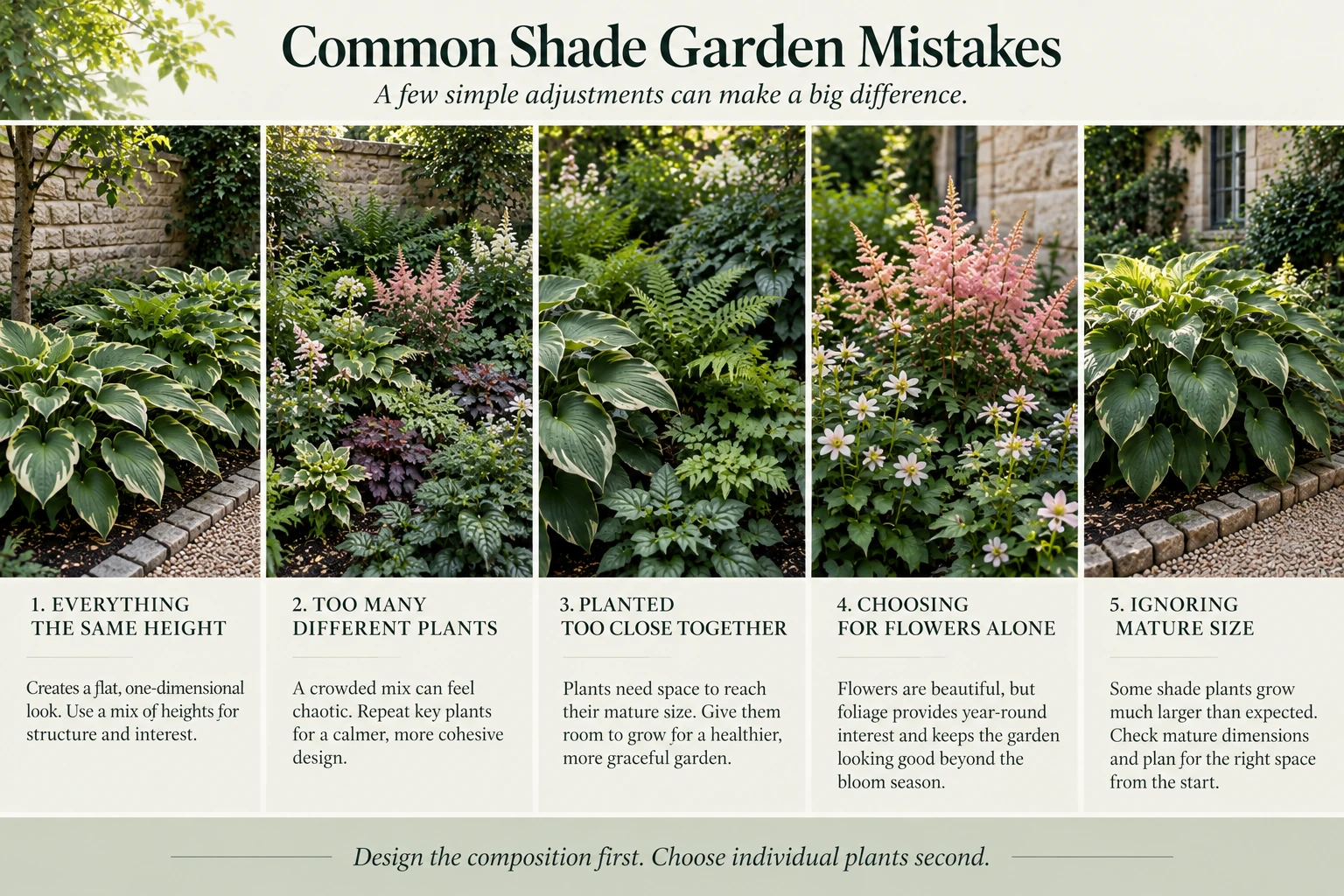
Before planting, step back and check the composition. Small adjustments on paper are much easier than moving mature plants later.
- Everything at the same height: add a clear anchor and a lower edge.
- Too many varieties: repeat successful plants before extending the palette.
- Planting too closely: measure mature spread and retain access.
- Choosing only for flowers: check whether the foliage works between flowering periods.
- Ignoring mature size: choose cultivars that fit the border, rather than relying on frequent cutting back.
Example: A Complete 12 × 6 ft Shade Garden
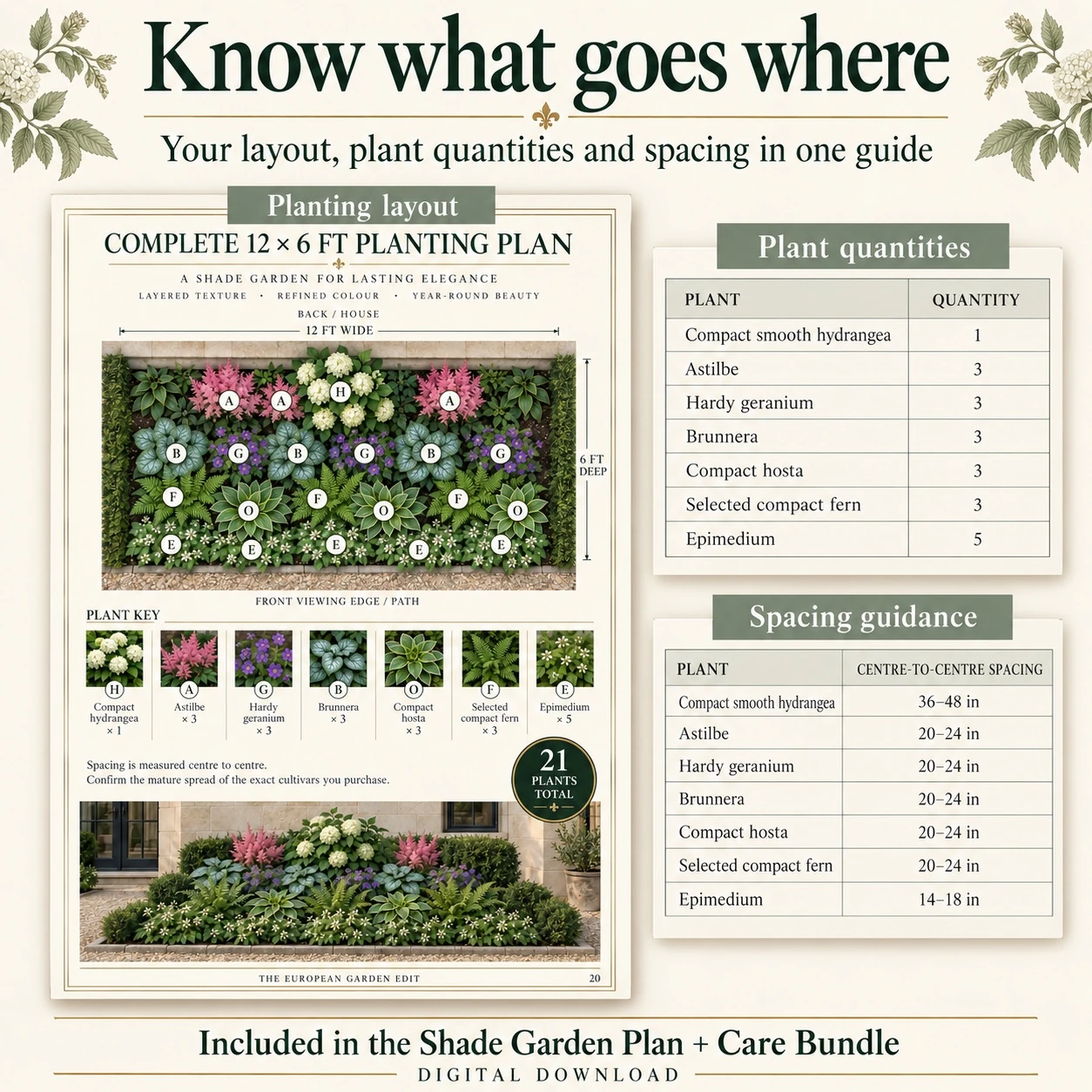
These principles can be applied to a defined border as well as a larger garden. In a 12 × 6 ft space, each plant needs a clear purpose, and spacing becomes especially important.
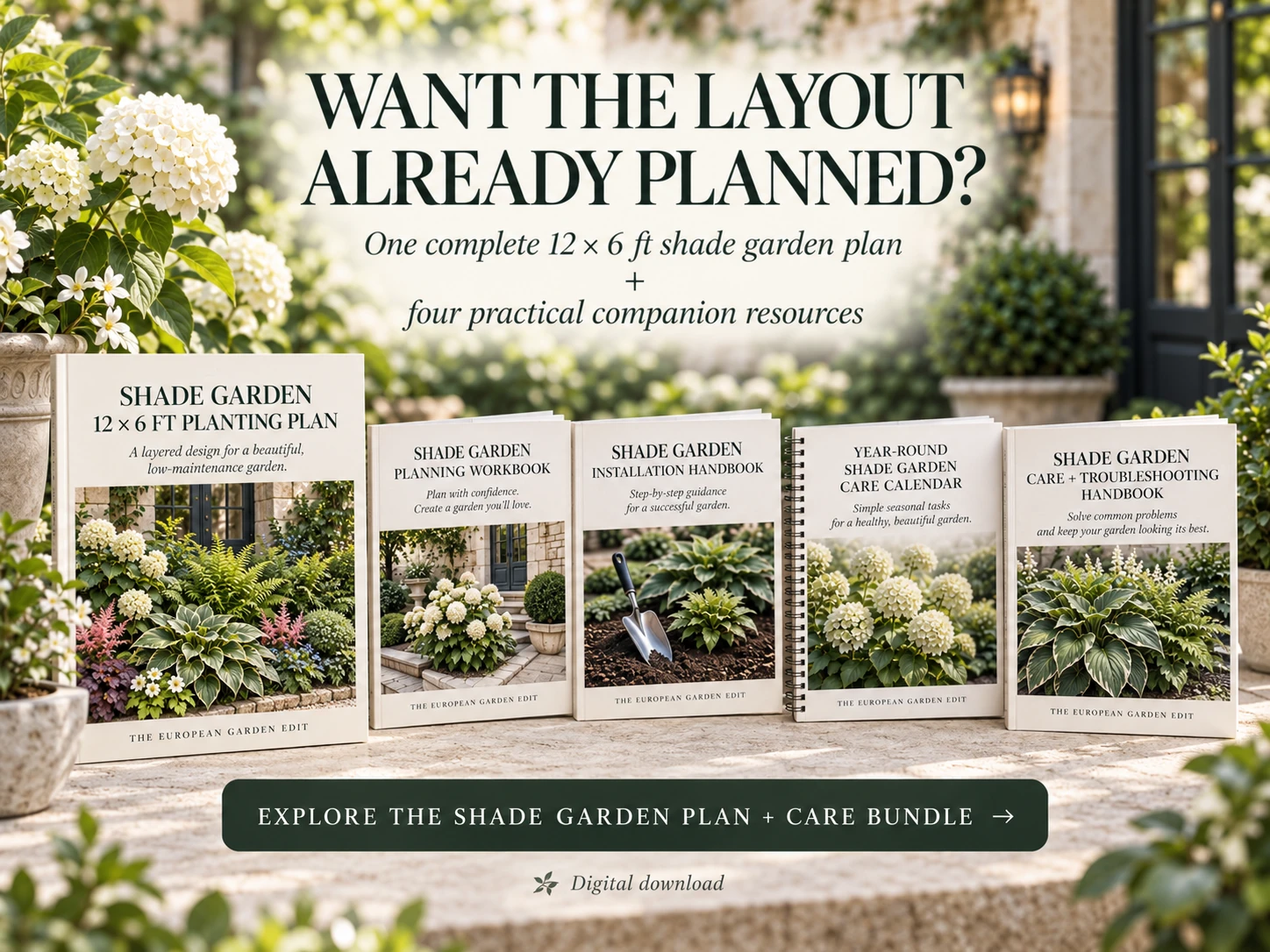
If you would rather begin with the layout already worked out, I created the Shade Cottage Garden Plan around these same principles. The plan brings together structural, middle and foreground planting, with plant placement, quantities and spacing to help translate the composition into the garden.
Use it as an example of how the layers work together, then check the recommended conditions against your own site. A border intended for bright part shade and evenly moist, well-drained soil should not be transferred unchanged into dry, deep shade beneath mature trees.
From Plan to Planted Garden
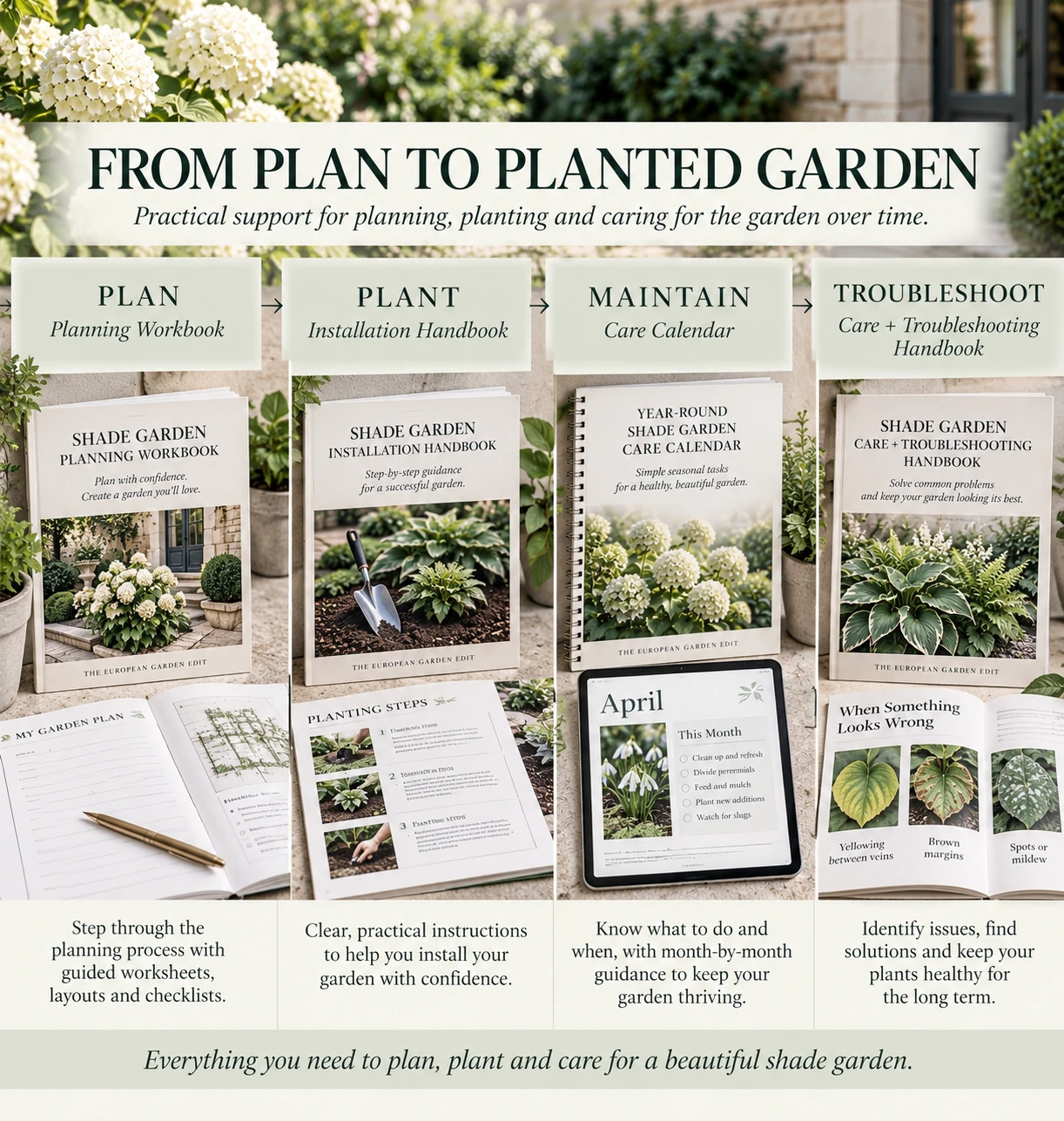
Designing the border is the beginning. Turning a layout into healthy planting also involves preparation, practical decisions and care as the garden establishes.
- Plan — Planning Workbook: organise site observations, measurements, plant purchases and garden notes before you begin.
- Plant — Installation Handbook: follow the preparation and planting process, including setting out plants before digging and checking spacing.
- Maintain — Year-Round Care Calendar: keep track of seasonal priorities, adapting timing to your climate and the garden’s growth.
- Troubleshoot — Care + Troubleshooting Handbook: work through symptoms, possible causes and practical checks when a plant is struggling.
The companion resources give you somewhere to record decisions and return to the next steps as the border develops.
Bringing It All Together
A beautiful shade garden grows from a few considered decisions: start with structure, build a generous middle layer and soften the foreground. Repeat strong plants, use foliage for lasting seasonal interest and leave room for each clump to mature.
Above all, match the planting to the shade and moisture you actually have. You can begin with one small area, observe how it grows and build from there. A border becomes cohesive through thoughtful relationships between plants, and those relationships are something you can plan.
Want the layout already planned?
The Shade Garden Plan + Care Bundle brings together the complete 12 × 6 ft Shade Cottage Garden Plan, Planning Workbook, Installation Handbook, Year-Round Shade Garden Care Calendar and Care + Troubleshooting Handbook.
These digital resources support you from planning and installation through seasonal care and troubleshooting, with a considered layout to begin from.
Shade Garden FAQs
What plants are good for a shade garden?
Hostas, ferns, hellebores, brunnera, epimedium, heuchera and astilbe offer a range of shapes and textures. Choose species and cultivars suited to your climate, light and soil moisture; plants for moist shade are not automatically suitable for dry shade.
How do you make a shade garden look lush?
Combine different heights, contrast broad and fine foliage, and repeat plants in groups. Allow those groups to develop at sensible spacing. Healthy growth and a connected composition create fullness more reliably than squeezing in extra plants.
Can hydrangeas grow in shade?
Many shrub hydrangeas suit part shade, but flowering usually declines in very dark positions. Requirements vary by species, cultivar and climate. Check the plant’s light recommendation and moisture needs before using it as your structural anchor.
What should I plant in front of hostas?
Try a compact heuchera, suitable epimedium, smaller fern or shade-tolerant hardy geranium. Match moisture needs and choose plants low enough to complement the hosta. Leave room for its mature leaves to spread without smothering the foreground.
How far apart should shade plants be?
Use the mature spread of the specific cultivar and measure centre to centre. Miniature hostas and large hostas need very different spacing. Follow a checked planting plan or nursery guidance, allowing extra clearance beside paths and buildings.
What is the difference between part shade and full shade?
Part shade commonly means around three to six hours of direct sun daily; full shade generally receives less than three. Definitions vary between plant references. Full shade may still have good indirect light, whereas deep shade is much darker.
Begin with a few plants that suit your garden, give them room and watch how they settle in. You may find that repeating a favourite fern or softening one stretch of path is enough to bring the border together. A shade garden takes shape over seasons, and there is pleasure in leaving yourself time to notice what works.
YOUR COMPLIMENTARY 6-PAGE GUIDE
Begin Your Shade Border with Confidence
Receive your complimentary copy of A Beautiful Shade Border, a beautifully designed six-page guide to understanding your shade, building three planting layers and sketching your own border.
COMPLIMENTARY PDF • INSTANT ACCESS
Plus occasional garden notes from The European Garden Edit. Unsubscribe anytime.
FROM THE JOURNAL
Recent Reads
September 17, 2026
How to Design a White Hydrangea Border
September 16, 2026
5 Beautiful Ways to Edge a Garden Border
September 12, 2026
How to Choose the Right Hydrangea for Your Garden
September 10, 2026
What to Plant, Prune and Notice This Season
September 10, 2026
How to Design a Mediterranean Front Entrance
September 7, 2026